In short
- Batt, 45, of Barry, accepted approximately £39,000 from a family in Risca, Caerphilly for building works that were left substantially incomplete and of extremely poor standard.
- An independent building surveyor found multiple Building Regulations failures and assessed the work as having "little monetary value."
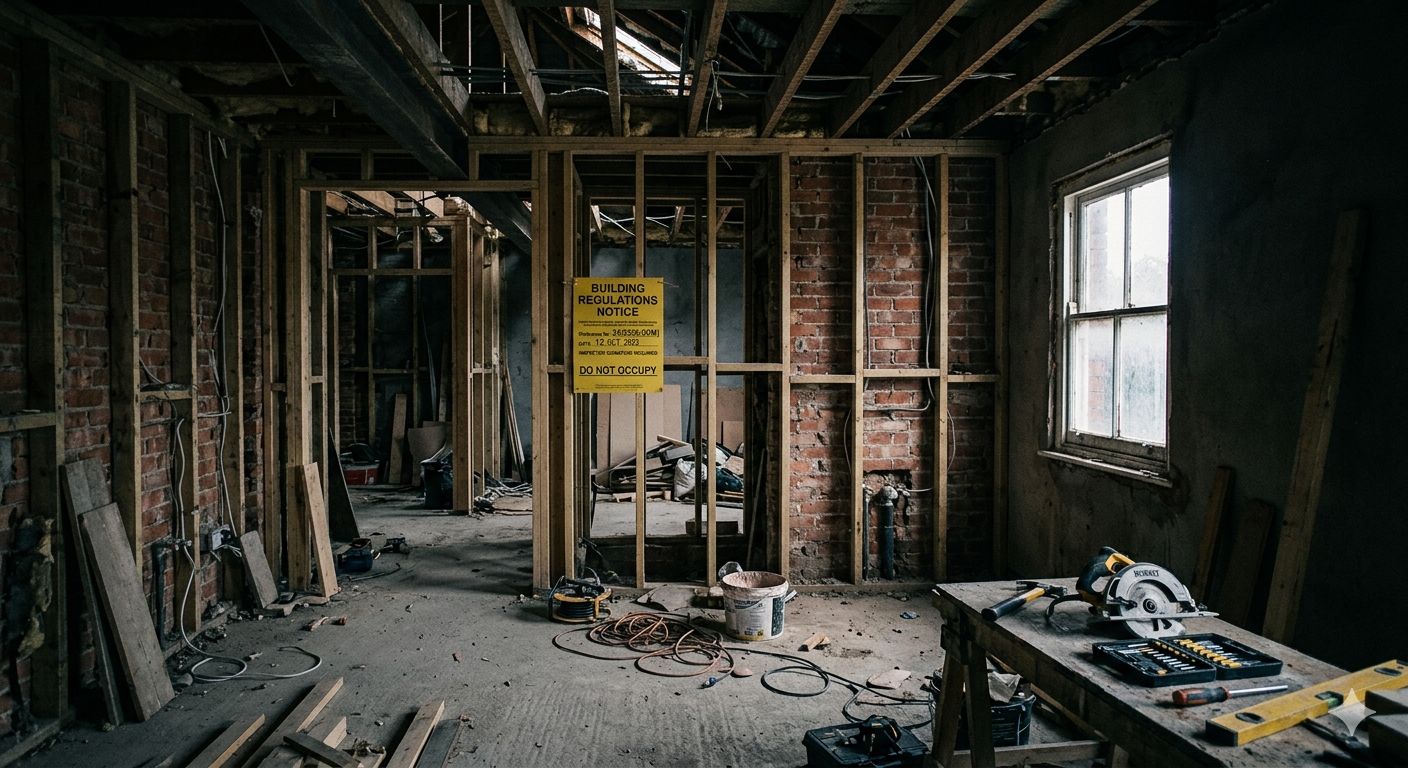
- The property was condemned as structurally unsafe. The family — including a young child — were forced to leave immediately.
- The family spent months eating meals in a garage they had converted into a makeshift kitchen. Remediation required demolishing and rebuilding the affected work at a cost of approximately £89,000.
- Batt was found guilty of fraud and offences under the Consumer Protection from Unfair Trading Regulations. He was sentenced to 9 months at Cardiff Crown Court on 21 May 2026. The prosecution was brought by Caerphilly County Borough Council Trading Standards.
- No prior Trading Standards history or criminal record was found in public sources — this was a first-time prosecution.
We won't always find a criminal record. Most rogue traders don't have one yet. What we will do is make you ask the right questions before the money leaves your account — and for a job like this, the questions matter.
Mark Anthony Batt had no prior convictions. He wasn't on a Trading Standards watch list. There was no company registered to his name that a Companies House search would flag. By the standard measures a homeowner might think to apply, he looked like a builder you could hire.
He accepted approximately £39,000 from a family in Risca for significant building works on their home. What followed placed them in genuine danger and left them without a functioning kitchen for months.
What the surveyor found
When Trading Standards instructed an independent building surveyor to assess the work, the findings were unambiguous. The completed work contained multiple Building Regulations failures. The surveyor's conclusion, as cited in the Caerphilly County Borough Council prosecution statement, was that the work had "little monetary value."
Building Regulations exist for a reason. The standards they set — structural integrity, fire resistance, drainage, insulation, load-bearing capacity — are not optional extras. Failing them at multiple points in a single job is not the outcome of inexperience. It is the outcome of work that was not carried out to any recognisable professional standard.
"Little monetary value." — Independent building surveyor's assessment of approximately £39,000 of completed work · Caerphilly County Borough Council prosecution, May 2026
The property was condemned as structurally unsafe. The condemnation was not a precautionary measure pending further inspection. The family — including a young child — were required to leave immediately.
Living in a garage
What followed the condemnation gives a clearer picture of what a prosecution outcome does not restore. The family spent months in disrupted accommodation while the scale of the damage was established and remediation was arranged.
They converted a garage into a makeshift kitchen. They cooked and ate their meals in a space that was never designed for the purpose, for an extended period, because the building Batt had been paid £39,000 to improve was no longer safe to occupy.
What a check would have found
There was no criminal record to find. There was no prior Trading Standards history in public records. But the absence of a record is not the same as a clean bill of health — and the signals that mattered here had nothing to do with his history.
Four signals that were checkable before any money changed hands
-
No registered company — unverifiable sole trader For a job of this scale — £39,000 for structural building work on a family home — the absence of any registered company is a material risk factor. An unregistered sole trader has no filed accounts, no verifiable trading history, and no corporate liability if things go wrong. A Companies House search takes two minutes. No result is not nothing: it is the first signal to investigate.
-
No trade body registration — no independent accountability For building works requiring Building Regulations compliance, membership of a recognised trade body — the Federation of Master Builders, TrustMark, or a competent person scheme — creates an independent accountability layer. No registration means no professional standards body to complain to, no indemnity insurance verification, and no vetted competence check. It does not mean fraud. It does mean that if something goes wrong, you have no external lever to pull.
-
Full payment upfront — no milestone structure A legitimate contractor on a job of this size ties payments to verified stages: foundations inspected and signed off, structure complete, roofing complete. A request for the full amount upfront — or for a deposit disproportionate to the materials required — removes the client's only practical leverage. Once the money is gone, it is gone. The right question before any payment above a few hundred pounds: what specifically will be complete before each payment is released?
-
Building Regulations — who was applying for approval? Structural building works on a home require Building Regulations approval — either from the local authority building control or a private approved inspector. This is not optional. If a builder does not raise the subject of Building Regulations, that is a direct signal that the work is not being done to a standard that will pass inspection. The question to ask before the quote is signed: "How will Building Regulations approval be obtained, and who is responsible for it?"
Planning any building work?
Before You Pay checks company registration status, trade body memberships, and scans quotes for the payment term patterns that appear in prosecutions like this one — including unstructured upfront demands and missing Building Regulations references.
Check your trader before you pay — £5 →The Caerphilly Trading Standards officer who led the prosecution noted that Batt "targeted a vulnerable family and took a significant amount of money from them, leaving them with an uninhabitable home." The family's vulnerability was not a precondition of the fraud — any homeowner commissioning significant building work on an upfront basis, without verifying trade credentials, is exposed to this risk. The record doesn't need to exist before the questions need asking.
Primary sources
What our system found
We ran Mark Anthony Batt through Before You Pay while writing this article. No company registered to his name appeared on Companies House. No TrustMark, FMB, or trade body registration was found. The quote scan flagged four concerns: full upfront payment, no milestone structure, no Building Regulations reference in the quote, and no written contract. We found no criminal record — there wasn't one. What we did find was a payment structure that gave the buyer zero practical leverage once the money left their account. The report below is real — exactly what a paying customer would have received.